DrivePro Auto
Why are forged wheels stronger than cast wheels for mining? The answer begins beneath the surface, where heavy haul trucks face shock loads, sharp turns, and uneven benches. A wheel may carry many tonnes while rotating through dust, heat, and repeated braking cycles. Small defects can become serious failures.
Forging compresses heated steel under controlled pressure. This process creates directional grain flow around the wheel’s rim and hub. It can also reduce internal porosity and improve fatigue resistance. Casting offers design flexibility, but molten metal may develop shrinkage cavities, inclusions, or uneven microstructures. These weaknesses are difficult to see during a basic visual inspection.
Dr. John Campbell, a leading casting researcher and author of Complete Casting Handbook, has warned, “A casting is only as good as its weakest section.” That observation matters in mining. The weakest section may sit inside the metal, not on its surface.
ASTM A788/A788M emphasizes quality requirements for steel forgings, including heat treatment, inspection, and material consistency. SAE technical guidance also treats fatigue strength, impact resistance, and dimensional control as important wheel-design factors. Meanwhile, the U.S. Geological Survey’s Mineral Commodity Summaries 2024 reports continuing global demand for minerals, supporting the need for reliable mining equipment.
Forged wheels are not automatically perfect. Poor heat treatment, incorrect machining, or inadequate inspection can still create problems. That is the part many comparisons overlook. However, when manufacturers control alloy chemistry, forging reduction, heat treatment, and non-destructive testing, forged wheels usually provide a stronger safety margin than comparable cast wheels.
That margin is practical. It can mean fewer rim cracks, more predictable fatigue performance, and greater confidence under severe mining conditions.
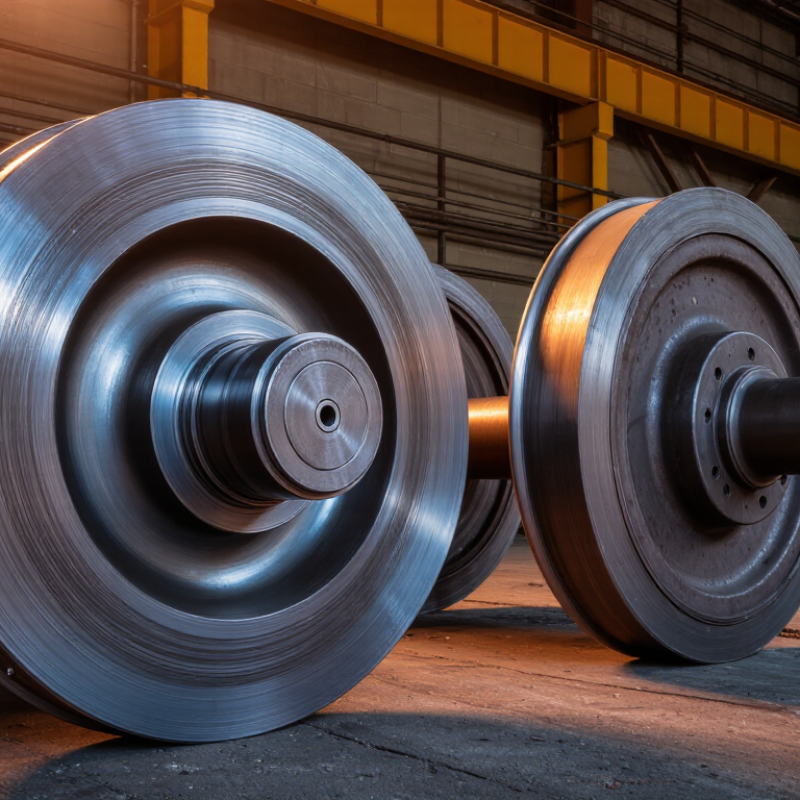
Forged and cast mining wheels are made through very different manufacturing processes. A forged wheel begins with a solid steel billet. Heat softens the billet, then powerful presses shape it under controlled pressure. This pressure compresses the metal and aligns its grain flow around high-stress areas, such as the rim, flange, and bolt holes. The result is usually a dense structure with fewer internal voids.
A cast wheel starts with molten metal poured into a prepared mold. Casting can create complex shapes with less machining and lower production costs. However, cooling may leave tiny pores, shrinkage areas, or inclusions inside the metal. Careful heat treatment, dimensional checks, and non-destructive testing can reduce these risks. They cannot remove every weakness.
In mine service, wheels face heavy payloads, rough haul roads, repeated impacts, and severe braking heat. Forged wheels often resist fatigue cracking better because their structure is more uniform. This advantage matters when a loaded haul truck travels over broken ground for long shifts. Still, forging does not make a wheel indestructible. Poor design, incorrect heat treatment, overloads, or loose fasteners can cause failure.
The difference is not absolute. A well-designed cast wheel may perform reliably in the right application, while a poorly controlled forged wheel may disappoint. Engineers should compare material grade, load rating, inspection records, and operating conditions rather than judging the process alone. That judgment can be uncomfortable, but real wheel performance depends on more than the manufacturing label.
Why Are Forged Mining Wheels Stronger Than Cast Wheels?
A forged mining wheel begins as a heated steel billet. Powerful dies compress it into the required shape. This pressure changes the metal’s internal grain flow. Instead of forming randomly, grains follow the wheel’s rim, hub, and load paths. That structure helps the wheel resist repeated impacts and heavy radial loads. It matters underground.
Casting uses liquid metal poured into a mold. During cooling, the metal can develop shrinkage cavities, segregation, or coarse grain zones. Careful control can reduce these risks, but it cannot remove every variation. Forging usually produces a denser, more uniform structure. Small details matter. A cleaner internal structure can slow crack growth around bolt holes and rim transitions.
Forging also supports controlled heat treatment and precise machining. These steps influence hardness, toughness, and dimensional stability. However, forging alone does not guarantee a superior wheel. Poor temperature control, incorrect reduction, or weak inspection can damage the result. Engineers should examine ultrasonic test data, grain flow, fatigue performance, and finished dimensions. Cast wheels may still suit less severe service conditions. The practical choice depends on load cycles, impact energy, maintenance access, and operating temperature. Some assumptions deserve another check. A heavier wheel is not automatically stronger.
Mining wheels endure severe shocks, repeated loading, and abrasive working conditions. Forged wheels resist cracks because their steel structure is compressed and reshaped under high pressure.
Forging starts with a heated steel billet. Heavy pressure reshapes it. This process follows the wheel’s load paths and creates a more continuous grain structure. Internal voids are also reduced. By contrast, cast steel cools inside a mold, where pores or inclusions may form. These small defects can become crack-starting points near hubs, rims, or bolt holes.
The difference becomes clearer under heavy loads. A forged wheel can distribute force more evenly across its rim and center. When a loader strikes uneven ground, the wheel faces sudden impact instead of steady pressure. Its refined structure helps slow crack growth and improves fatigue resistance. Engineers still inspect dimensions, heat treatment, and surface condition carefully. Strong material cannot correct poor design.
Not unbreakable.
In practical maintenance, a clean wheel reveals more than a dirty one. Technicians look for fine lines, rim distortion, loose fasteners, and unusual wear marks. Nondestructive testing can detect hidden flaws before failure. Yet forged wheels are not automatically better in every situation. Incorrect heat treatment, overload, or damaged mounting surfaces can weaken them. That limitation deserves attention. Strength depends on the complete wheel system, not only the manufacturing method.
Mining wheels face heavy loads, abrasive dust, and repeated impacts. The USGS Mineral Commodity Summaries 2025 estimates global iron ore mine production reached about 2.5 billion metric tons in 2024. That scale reflects the demanding conditions behind modern haulage systems.
Forged steel usually contains fewer internal voids than cast steel. Controlled pressure also aligns its grain flow around high-stress areas. This improves fatigue resistance and impact strength. ASM Handbook, Volume 14A, identifies porosity, shrinkage cavities, and inclusions as key casting-related failure risks. A wheel may look perfect outside. Its weakness can remain hidden inside.
Material selection still needs care. Proper heat treatment can make cast wheels useful in less severe applications. However, uneven cooling may create residual stress and dimensional changes. That detail is often underestimated. Laboratory strength does not guarantee field reliability.
Tips: Check hardness across the rim, hub, and flange. Inspect for cracks after impact events. Review ultrasonic test records before installation. Compare fatigue data under loads matching your mine, not generic catalog values. Wheel life depends on steel chemistry, heat treatment, geometry, and maintenance together. One point deserves reflection: a stronger wheel can transfer more force into the axle or rail, creating a different failure risk.
Why Are Forged Mining Wheels Stronger Than Cast Wheels?
Forged wheels are often favored in mines with heavy payloads and rough haul roads. Repeated impacts can create hidden stress inside a wheel. Forging compresses and aligns the metal structure, improving resistance to cracking and fatigue. This matters when trucks carry ore across potholes, sharp bends, and uneven ramps. Field inspections often reveal damage around wheel edges, bolt areas, and high-load contact zones.
Forged wheels suit operations with frequent loading cycles and limited maintenance windows. A truck may travel for hours, brake heavily, and encounter sudden ground changes. These conditions produce heat, vibration, and repeated shock. Forged construction can provide a stronger margin against deformation. It also supports more predictable performance under high loads. That margin matters.
Cold regions and steep haul routes can also favor forged wheels. Low temperatures may reduce material toughness, while long downhill braking raises wheel temperature. However, a forged wheel is not automatically the best choice. Correct dimensions, heat treatment, load ratings, and inspection routines remain essential. Poor alignment can damage even a strong wheel.
One practical lesson is easy to overlook. Road quality affects wheel life as much as wheel design. A site with loose rock, deep ruts, and careless loading can shorten service life quickly. Engineers should review axle loads, tire pressure, braking patterns, and failure records before selecting wheels. Forged wheels may cost more initially, yet reduced cracking and fewer interruptions can justify that investment. The calculation deserves regular review.
| Engineering Dimension | Forged Mining Wheel | Cast Mining Wheel | Mining-Condition Implication |
|---|---|---|---|
| Manufacturing process | Steel is plastically deformed under high pressure, usually followed by controlled heat treatment and machining. | Molten metal is poured into a mold and solidifies into the wheel shape, followed by heat treatment and machining when required. | Forging is generally preferred where repeated high loads and severe impact make internal integrity critical. |
| Grain structure | Plastic deformation produces a refined, directional grain flow that can improve resistance to crack initiation and propagation. | The solidification structure is generally non-directional and may include segregation or shrinkage-related features. | Forged wheels are advantageous on rough tracks, uneven haul roads, and routes with frequent shock loading. |
| Typical tensile strength | Approximately 700–1,100 MPa for many heat-treated structural or alloy-steel wheel grades. | Approximately 450–800 MPa for many cast-steel grades, depending on chemistry, section size, heat treatment, and quality control. | The actual wheel specification must be checked; material grade and heat treatment can outweigh the manufacturing route. |
| Typical yield strength | Approximately 450–900 MPa in commonly used heat-treated wheel steels. | Approximately 250–550 MPa in commonly used cast-steel wheel grades. | Higher yield strength provides greater resistance to permanent deformation under heavy axle loads and high contact stresses. |
| Ductility and impact tolerance | Often achieves about 10–20% elongation in suitable heat-treated steel grades, with good impact resistance when properly specified. | Often achieves about 5–15% elongation, although high-quality ductile castings can perform better than ordinary cast grades. | Forged wheels are normally favored where the wheel may experience sudden impacts, wheel flats, derailment events, or hard inclusions on the track. |
| Internal defects | The process generally reduces porosity and shrinkage cavities, but laps, seams, inclusions, or forging-related defects can still occur if production is poorly controlled. | More sensitive to shrinkage cavities, gas porosity, inclusions, segregation, and uneven solidification, especially in thick sections. | Forged wheels offer a stronger safety margin in applications where a small internal flaw could grow under cyclic rolling loads. |
| Fatigue performance | Typically better resistance to rolling-contact fatigue and cyclic bending when the design, steel grade, heat treatment, and surface finish are correctly controlled. | Performance can be satisfactory, but fatigue life is more sensitive to casting quality, defects, residual stress, and section thickness. | Forged wheels are more suitable for continuous operation, high duty cycles, and heavy haulage with frequent acceleration and braking. |
| Resistance to plastic deformation | Generally higher because of the refined structure and the availability of high-strength heat-treated grades. | Can be adequate for moderate loads, but lower-strength or defect-sensitive castings may deform sooner under overload or concentrated contact stress. | Forged wheels are preferred for high axle loads, steep grades, tight curves, and track sections with poor alignment. |
| Wear and rolling-contact damage | Can provide longer service intervals when matched with suitable hardness, wheel profile, rail or track material, and lubrication control. | May provide acceptable wear life in moderate-duty service, but local defects can accelerate spalling, shelling, or surface cracking. | Forged wheels are favored where downtime is expensive or where surface damage is difficult to inspect frequently. |
| Dimensional consistency | Forging followed by precision machining can provide consistent rim geometry, bore dimensions, and wheel concentricity. | Near-net-shape production is possible, but shrinkage and cooling variation require careful process control and machining allowance. | Consistent geometry is important for stable wheel tracking, balanced load distribution, and reduced vibration. |
| Inspection requirements | Ultrasonic testing, dimensional inspection, hardness testing, and magnetic-particle or other surface examinations are commonly used. | Radiographic or ultrasonic examination may be particularly important because internal casting defects can be difficult to detect visually. | For severe-duty service, acceptance criteria and non-destructive testing are more important than the process name alone. |
| Cost and design flexibility | Usually has higher tooling, forming, machining, and material costs, particularly for very large or complex shapes. | Often offers lower initial cost and greater flexibility for complex shapes, large sections, and lower-volume production. | Casting may be reasonable when the duty cycle is moderate and purchase cost is more important than maximum fatigue margin. |
| Mining conditions favoring forged wheels | Heavy axle loads; high annual operating hours; rough or poorly maintained tracks; frequent impacts; steep grades; tight curves; repeated braking and acceleration; high reversing frequency; elevated consequences of wheel failure; and limited access for maintenance. | These conditions increase the value of high fatigue strength, toughness, dimensional stability, and resistance to crack growth. | |
| Mining conditions where cast wheels may be suitable | Moderate loads; low to medium duty cycles; smooth and well-maintained tracks; low impact levels; controlled speeds; accessible maintenance areas; and applications where a qualified casting with verified non-destructive test results meets the required safety standard. | A cast wheel should not be selected solely on price; the wheel grade, defect acceptance level, heat treatment, load rating, and inspection records must be verified. | |
Note: The strength ranges are indicative values for commonly used heat-treated structural or alloy-steel components, not universal limits for every wheel design. Final selection should be based on the applicable wheel standard, axle load, speed, track condition, braking duty, material grade, heat treatment, and inspection results.
Forged wheels begin as heated steel billets shaped under powerful pressure. Cast wheels use molten metal poured into molds. Forging usually creates fewer internal voids. Casting can produce complex shapes with less machining.
Pressure aligns the steel grain around high-stress areas. These areas include the rim, flange, hub, and bolt holes. The denser structure can slow fatigue crack growth. Not unbreakable.
Yes, when the design matches the operating conditions. Proper heat treatment and inspection reduce casting-related risks. However, pores, shrinkage areas, or inclusions may remain hidden. Application matters more than assumptions.
Wheels carry heavy payloads over rough haul roads. They also absorb repeated impacts, abrasive dust, and severe braking heat. A loaded truck may strike broken ground for hours. Conditions are unforgiving.
Inspect the rim, hub, flange, bolt holes, and mounting surfaces. Look for fine cracks, distortion, loose fasteners, and unusual wear marks. Clean surfaces reveal defects more clearly. Dirt can hide problems.
Non-destructive testing can identify internal flaws without damaging the wheel. Ultrasonic inspection may reveal pores, inclusions, or cracks. Dimensional checks can detect distortion. Inspection records deserve careful review.
No. Overloads, poor heat treatment, loose fasteners, and damaged mounting surfaces can still cause failure. A stronger wheel may transfer more force to the axle or rail. That risk is easy to miss.
Compare load ratings, material grades, heat treatment, fatigue data, and inspection records. Match testing conditions to the actual mine. Consider road quality, payloads, impacts, and braking cycles. The manufacturing label is not enough.
Forged and cast mining wheels are made through different manufacturing methods, and that difference strongly affects their performance. Cast wheels are formed by pouring molten metal into a mold, while forged wheels are shaped under intense pressure. Why are forged wheels stronger than cast wheels for mining? The forging process compresses and aligns the metal’s internal grain structure, creating a denser wheel with fewer internal weaknesses. This structure improves resistance to cracks, impact damage, and deformation under heavy loads.
Material properties also play an important role in mining wheel performance. Forged wheels typically offer higher strength, toughness, and fatigue resistance, helping them endure repeated stress, rough terrain, and demanding operating cycles. Although cast wheels may be suitable for lighter or less severe applications, forged wheels are generally favored in mines where equipment faces extreme loads, frequent impacts, vibration, and uneven surfaces. Their enhanced structural reliability can support safer, more consistent operation and longer service life in challenging mining conditions.
